
History of Ceramics
Ceramics is perhaps humanity's oldest story. Long before writing, people took clay, shaped it, fired it, decorated it — and have never stopped since. Around the Mediterranean and on the shores of North Africa, this story has been written over millennia, from hand to hand, from shore to shore. The Dar Jaziri collection follows its thread; this page gives you its main stages.

2,500 years at a glance
Antiquity
-
Punic & Roman potters of Carthage
8th–13th c.
-
the rise of Islamic ceramics, from Kashan to Granada
13th–15th c.
-
splendour of Hispano-Moorish art
16th–17th c.
-
the heyday of Iznik (Turkey)
17th–19th c.
-
Tunisian schools: Qallaline, Nabeul
20th c.–today
-
living traditions & contemporary creation


The Islamic world
Long before our era, Punic and then Roman potters made Carthage and its surroundings a great ceramic centre. Trade amphorae, glazed tableware, oil lamps: terracotta is already everywhere, an everyday object and a currency of exchange along every route of the Mediterranean.
Antiquity / Carthage
From the 8th century, the Islamic world turned ceramics into a major art. Opaque glaze, lustre decoration with metallic reflections and deep blues were invented. Faience ceased to be a mere container: it became a surface to paint, a support for floral, geometric and calligraphic motifs of infinite subtlety.
Behind this revolution lay a model from very far away: Chinese porcelain. Arriving along the Silk Roads, it fascinated the potters of Iran, who sought to recapture its whiteness and fineness. In Kashan, then in the Safavid workshops, they perfected a very light siliceous body and adopted blue-on-white decoration, stylised clouds, lotus flowers, phoenixes and dragons. Relayed by Persia, the Chinese inspiration spread across the entire Islamic world, as far as Iznik, and eventually reached the shores of the Mediterranean.
Andalusia
In Muslim Spain, this heritage gave birth to the Hispano-Moorish style, a pinnacle of refinement exported throughout the Mediterranean. When, in 1492, Muslims and Jews were expelled from Spain, they carried this knowledge to North Africa — and reinvented it, notably in Tunisia.
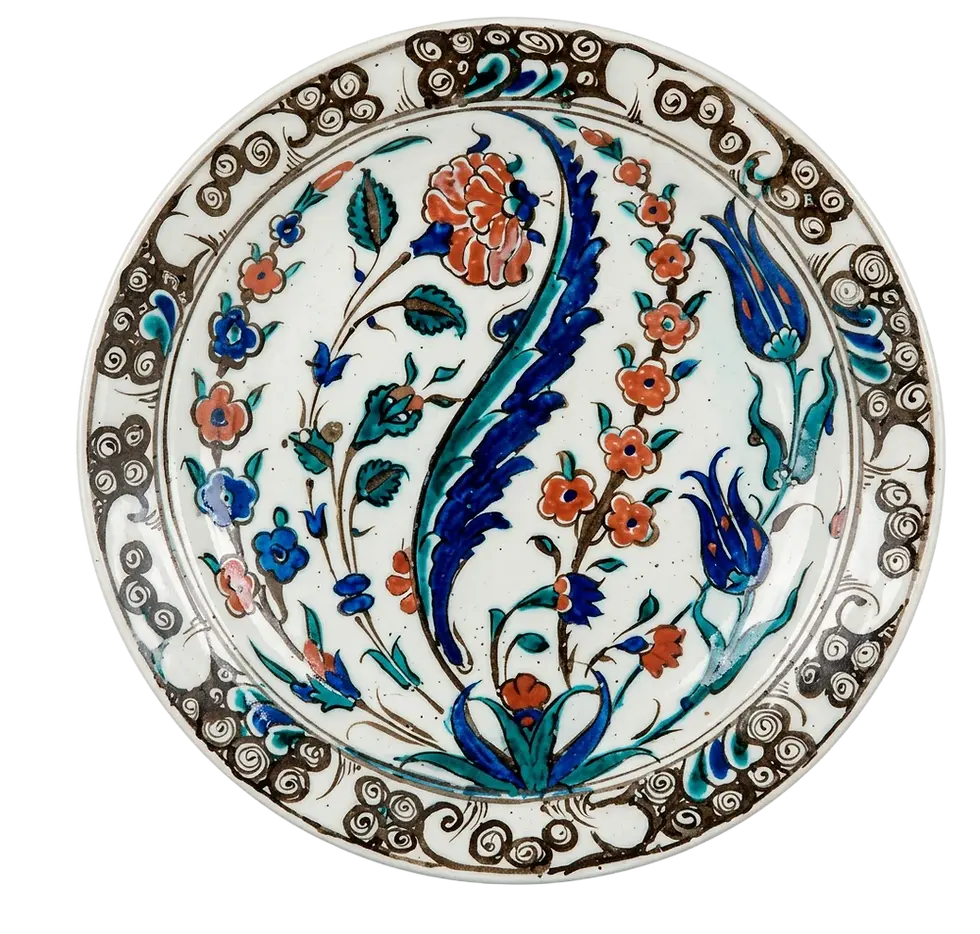
Iznik — Ottoman brilliance
In the 16th and 17th centuries, the Ottoman workshops of Iznik took faience to an unequalled peak: brilliant whites, intense blues, that famous raised "tomato" red, blooming tulips and carnations. Their influence radiated across the whole Mediterranean basin, Tunisia included.

The Tunisian schools
Nourished by all these currents, Tunisia developed its own traditions. From the 17th to the 19th century, the workshops of Qallaline, in Tunis, produced panels and tiles that clad palaces and residences. Then Nabeul asserted itself as a pottery town, brilliant and flowery, while Djerba carried on at Guellala a thousand-year-old Berber tradition of bare clay.

Today
A living tradition — Tunisian ceramics do not belong to the past. In Nabeul, in Guellala, in a thousand workshops, the clay is still turning; contemporary artisans and artists carry on and reinvent this thousand-year-old gesture. History is still being written — and you can hold a chapter of it in your hands.